


The Reality of Finding Housing with a Rottweiler
Apartments that allow rottweilers exist, but finding them requires strategy and preparation. Many rental properties maintain breed restriction lists that include Rottweilers, often due to insurance policies or landlord concerns about liability. The good news? More communities are recognizing that responsible ownership matters more than breed stereotypes.
Quick steps to find Rottweiler-friendly apartments:
- Search with specific filters - Use rental websites that let you filter for "no breed restrictions"
- Build a pet portfolio - Include vet records, training certificates, and reference letters
- Get proper insurance - Secure renter's insurance with pet liability coverage
- Contact properties directly - Ask about specific pet policies before applying
- Know your rights - Service animals have legal protections under the Fair Housing Act
The challenge is real. Research shows that Rottweilers appear on most restricted breed lists alongside Pit Bulls, German Shepherds, and Dobermans. Landlords worry about insurance premiums, potential property damage, and liability risks. But these concerns often stem from outdated stereotypes rather than evidence about individual dogs.
This guide will show you how to overcome these barriers. You'll learn how to present your Rottweiler as the well-trained companion they are, where to focus your search efforts, and what legal protections exist. Whether you're moving to a new city or just need a bigger space, finding housing shouldn't mean leaving your family member behind.
The Lawrence House Apartments understands that pets are family. Our community welcomes responsible pet owners and provides amenities designed for urban living with dogs.
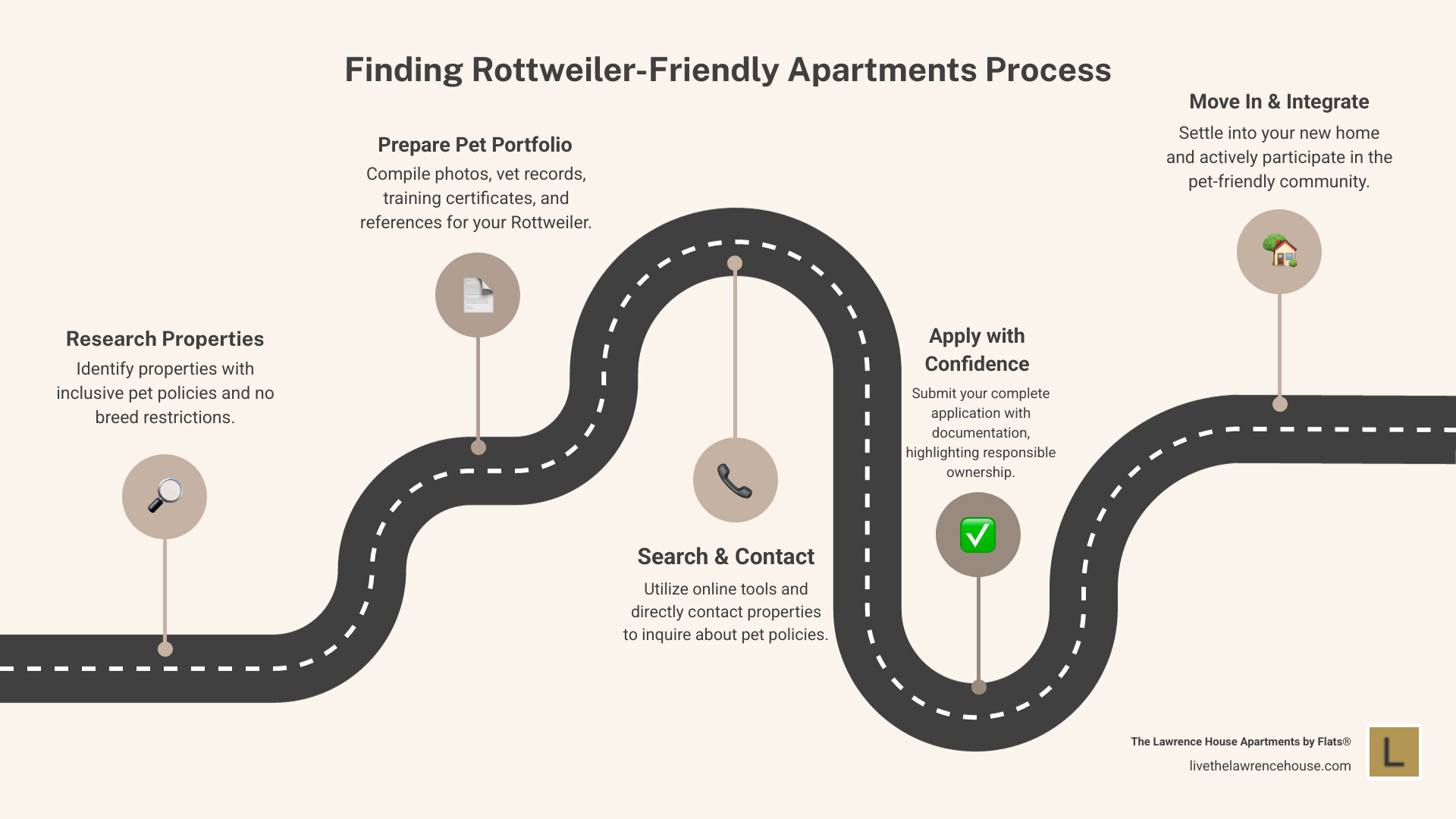
Step 1: Research properties with inclusive pet policies | Step 2: Prepare your pet portfolio with photos, vet records, and references | Step 3: Search using online tools and contact properties directly | Step 4: Apply with your complete documentation and demonstrate responsible ownership | Step 5: Move in and integrate into your new pet-friendly community
Understanding the Challenge: Why Rottweilers Face Breed Restrictions
Finding apartments that allow rottweilers starts with understanding why these restrictions exist in the first place. It's frustrating, especially when your gentle giant wouldn't hurt a fly, but knowing the landlord's perspective helps you address their concerns head-on.
Breed restriction policies are surprisingly common across rental properties. Large management companies and individual landlords alike maintain lists of breeds they won't accept, and Rottweilers almost always make that list. These policies aren't usually personal—they're business decisions driven by very real financial pressures.
The biggest factor? Insurance liability concerns. Many property insurance providers have their own restricted breed lists, and they either charge significantly higher premiums or flat-out refuse to insure properties that house certain breeds. When a landlord's insurance company says "no Rottweilers," the landlord often has little choice but to comply. It's not about your specific dog—it's about keeping their property insured at all.
Beyond insurance, landlords worry about potential property damage and perceived risks to other residents. These concerns are usually based on stereotypes rather than evidence about individual dogs, but they're nonetheless part of the decision-making process. A landlord who's never met your well-mannered Rottweiler only has media stories and insurance warnings to go on.
Common restricted breed lists typically include Akitas, American Bulldogs, American Pit Bull Terriers, Staffordshire Terriers, Chows, German Shepherds, Doberman Pinschers, Great Danes, Huskies, Malamutes, Mastiffs, Pit Bulls, and Rottweilers. These restrictions often apply to both purebreds and mixed breeds that even vaguely resemble these dogs.
Here's the disconnect: Rottweiler stereotypes versus reality couldn't be more different. Responsible Rottweiler owners know these dogs are loyal, intelligent, and affectionate family members. They're often gentle with children and incredibly protective of their loved ones. With proper training and socialization, Rottweilers make excellent apartment companions. But changing perceptions takes work, which is why the rest of this guide focuses on demonstrating exactly that.
The good news? You're not powerless in this situation. Being proactive and prepared to showcase your Rottweiler's true temperament can make all the difference.
| Pet Policy Type | Description | Common Restrictions |
|---|---|---|
| No Pets Allowed | Strictly prohibits all animals on the property. | No animals permitted under any circumstances (except service animals). |
| Pet-Friendly (with restrictions) | Allows pets, but with specific rules and limitations. | Breed restrictions, weight limits, pet fees, pet rent, number of pets. |
| Pet-Inclusive | Welcomes all pets, often with no breed or weight restrictions. | May still have a limit on the number of pets per unit. |
What "Pet-Friendly" Really Means
The term "pet-friendly" sounds straightforward, but it's anything but. When searching for apartments that allow rottweilers, you'll quickly find that this label means something different at every property.
A building might proudly advertise itself as pet-friendly while maintaining a weight limit of 25 to 50 pounds. That immediately disqualifies most Rottweilers, who typically weigh between 80 and 135 pounds. Other properties limit the number of pets allowed—usually capping it at two per unit—which might work for you but doesn't address the breed question.
Then there are breed-specific rules that lurk in the fine print. A property might not have a strict weight limit but still maintains a breed restriction list. Some go even further, stating that management reserves the right to deny any dog that "resembles" a restricted breed. That kind of subjective language can work against Rottweiler owners, even with mixed breeds.
This is why reading the actual lease and pet policy is non-negotiable. A friendly leasing agent's verbal assurance means nothing if the written policy says otherwise. Get everything in writing before you pay any fees or sign anything.
The importance of reading the lease can't be overstated. Look for specific language about breeds, weight limits, pet deposits, monthly pet rent, and any other restrictions. If something seems unclear, ask for clarification in writing. You need to know exactly what you're agreeing to before you commit.
For a deeper understanding of what truly makes a building welcoming to pet owners, check out our guide on pet-friendly buildings. It breaks down the differences between properties that merely tolerate pets and those that genuinely welcome them as part of the community.
Strategies for Securing Apartments that Allow Rottweilers
The path to finding apartments that allow rottweilers starts with taking control of the narrative. Instead of waiting for landlords to judge based on breed alone, responsible ownership means showing them exactly who your dog is before they can make assumptions. Open communication and a well-prepared presentation can transform skepticism into acceptance.
Think of this process like applying for a job—except your Rottweiler is the candidate. Just as you wouldn't show up to an interview unprepared, your dog deserves the same professional approach. The difference between hearing "no" and "welcome home" often comes down to how thoroughly you've documented your pet's stellar character.

Create a Winning Pet Portfolio
A comprehensive pet portfolio—essentially your dog's resume—is one of the most powerful tools for changing minds. This document introduces your Rottweiler on your terms, highlighting their best qualities before stereotypes can take hold.
Start with high-quality photos that show your dog in their best light. Choose images where they look calm, well-groomed, and happy. Skip the action shots of them mid-play; you want photos that radiate "responsible family member" rather than "high-energy liability."
Include a thoughtful description of your dog's history and temperament. Share their daily routine, how they interact with neighbors and other animals, and what makes them special. Does your Rottweiler spend their afternoons napping in sunbeams? Are they house-trained and crate-trained? Do they have a favorite toy or a gentle way with children? These personal details humanize your pet beyond breed labels.
Documentation matters enormously. Attach current vet records showing up-to-date vaccinations, regular wellness visits, and proof of spaying or neutering. A clean bill of health from a licensed veterinarian reassures landlords that your dog receives consistent, professional care.
Any training certificates belong front and center in this portfolio. Obedience training completion, Canine Good Citizen certification, or specialized training courses all demonstrate your commitment to raising a well-mannered companion. For a helpful starting point, check out this Pet Resume template that walks through the essentials.
Gather Positive References and Certifications
Your Rottweiler's character witnesses can make all the difference. Just as employers want to hear from previous supervisors, landlords value hearing from people who've interacted with your dog professionally.
Letters of recommendation from previous landlords carry tremendous weight. A former property owner who can confirm your dog never caused damage, never generated noise complaints, and lived peacefully alongside neighbors provides exactly the reassurance new landlords need. These letters speak to both your dog's behavior and your reliability as a tenant.
Your veterinarian's endorsement offers another layer of credibility. A letter from your vet confirming regular care, good health, and a calm temperament during visits shows consistent responsible ownership. Veterinarians see countless dogs—when they vouch for yours, it means something.
If you've worked with a professional dog trainer, their recommendation adds objective evidence of your Rottweiler's obedience and good manners. Trainers can speak to your dog's responsiveness, socialization skills, and training progress in ways that carry professional authority.
The Canine Good Citizen (CGC) certificate deserves special mention. This American Kennel Club program tests dogs on ten skills, including accepting friendly strangers, walking politely on a leash, and remaining calm around distractions. Earning this certification provides concrete, third-party validation that your Rottweiler has excellent manners and training. Some landlords who maintain breed restrictions have been known to make exceptions for CGC-certified dogs—it's that powerful.
Demonstrate Financial Responsibility
Landlords' concerns about pets often come down to financial risk. Address these worries head-on by showing you're prepared for any scenario.
Renter's insurance with pet liability coverage is perhaps the most convincing tool in your arsenal. This coverage protects landlords from financial exposure related to dog-related incidents, whether property damage or injury. Several insurance providers offer policies that include liability coverage for dogs, even breeds on restricted lists. The coverage typically offers substantial protection, providing peace of mind for both you and your landlord.
When researching providers, consider companies like State Farm, Farmers Insurance Group, AAA, Amica, Auto-Owners Insurance, and Nationwide—which sometimes insures dogs with CGC certification. For veterans, United Services Automobile Association offers options, while Chubb Group, Lester Kalmanson Agency Inc., and XINSURANCE provide additional alternatives.
Offering an additional pet deposit shows you're willing to back your confidence in your dog's good behavior with financial commitment. While standard pet deposits are common practice, volunteering to increase this amount can ease landlord concerns about potential damage.
Understanding the full financial picture helps you budget appropriately. Beyond deposits, many properties charge non-refundable pet fees at move-in and monthly pet rent throughout your lease. Being prepared for these costs and discussing them openly shows landlords you've done your homework and take financial obligations seriously.
For a comprehensive look at the costs and considerations when renting with pets, explore more about pet-friendly apartments and what makes a rental truly welcoming to four-legged family members.
Navigating Your Search: Where to Find Welcoming Housing
The search for apartments that allow rottweilers doesn't have to feel overwhelming. Yes, it takes patience and persistence, but with the right approach and resources, finding a welcoming home for both you and your four-legged family member is absolutely possible.

Using Online Search Tools and Databases
The internet has transformed how people search for housing, and that's especially true when looking for rentals that welcome Rottweilers. Most apartment search websites offer basic pet-friendly filters, but the real key is drilling down further. Look for options that specifically say "no breed restrictions" or "all breeds welcome." This simple filter can save hours of disappointment.
Several dedicated platforms focus specifically on dog-inclusive rentals. The National Dog Inclusive Rental Database serves as an excellent starting point, though it's always smart to contact properties directly to confirm current policies. Major platforms like Zillow, Apartment Guide, Apartment List, and RentCafé all offer robust search features. More specialized sites like People With Pets, RentLingo, and Rentberry cater specifically to pet owners facing similar challenges.
The Lawrence House understands that your Rottweiler is part of your family. That's why our pet-friendly options are designed to make both you and your companion feel at home in Uptown Chicago.
Identifying Promising Properties
Not all pet-friendly properties are created equal. When searching for apartments that allow rottweilers, pay close attention to communities that don't just tolerate pets—they celebrate them. Properties with thoughtful pet amenities often signal a genuinely welcoming attitude toward dogs of all breeds and sizes.
On-site dog parks or designated pet relief areas show that management values the pet-owner experience. These spaces give Rottweilers room to stretch their legs and socialize safely. Pet washing stations are another green flag—they demonstrate practical thinking about the realities of dog ownership, especially after muddy walks through Chicago weather.
Some properties go even further with features like private yards or dog-safe balconies. While The Lawrence House sits in the heart of vibrant Uptown Chicago, the surrounding neighborhood offers plenty of green spaces and parks where Rottweilers can thrive. The urban setting doesn't mean compromising on quality of life for your companion. If you're exploring dog-friendly apartments near you, consider how the surrounding neighborhood complements the building's amenities.
Understanding the Costs
Budgeting for a rental with a Rottweiler means accounting for several pet-related expenses beyond your monthly rent. Being prepared for these costs helps avoid surprises during the application process.
Pet deposits are typically one-time charges collected when signing the lease. These can be either refundable or non-refundable, depending on the property. Research shows these deposits often fall between $250 and $500 per pet in cities like Chicago, though they can range from 40% to 85% of monthly rent depending on the property type.
Pet fees differ from deposits—they're usually non-refundable, one-time payments required to allow your Rottweiler on the property. In Chicago, these commonly range from $250 to $350.
Monthly pet rent is an ongoing charge added to your regular rent payment. This recurring fee typically runs between $25 and $50 per pet each month. While it might seem like a small amount, it adds up over the course of a year.
The type of property influences these costs significantly. Luxury buildings in sought-after neighborhoods might have higher deposits and monthly charges compared to mid-range communities. The important thing is getting every pet-related cost in writing before signing anything. Transparency about these expenses helps ensure there are no misunderstandings down the road.
Understanding Your Rights: Service Animals and Housing Laws
When a Rottweiler serves as a service animal, the conversation about housing changes completely. Federal laws provide powerful protections that can override typical breed restrictions and pet policies. These protections exist to ensure that people with disabilities have equal access to housing, regardless of their service animal's breed.

Service Animals vs. Emotional Support Animals
The legal distinction between service animals and emotional support animals is significant, and understanding it can make all the difference when searching for apartments that allow rottweilers.
Service animals are dogs that have been individually trained to perform specific tasks for someone with a disability. The task must directly relate to the person's disability. This could mean guiding someone who is visually impaired, alerting someone with hearing loss to sounds, pulling a wheelchair, assisting with balance and stability, or retrieving items. The key is that the animal performs observable work or tasks that help mitigate the disability.
Emotional support animals provide therapeutic benefits through their companionship. They offer comfort and emotional support to individuals with mental or emotional disabilities, but they don't require specialized training to perform specific tasks. Their presence alone provides the benefit.
Both types of assistance animals can be Rottweilers. Both provide invaluable support to their handlers. But the legal protections and housing rights differ between these two categories. For detailed definitions and requirements, the Americans with Disabilities Act (ADA) provides comprehensive guidance, and information on service animals from the ADA can help clarify specific situations.
Protections Under Federal Law
Two major federal laws protect people with disabilities who rely on assistance animals, and these protections can be especially important for Rottweiler handlers facing breed restrictions.
The Fair Housing Act (FHA) prohibits housing discrimination based on disability. Under this law, housing providers must make reasonable accommodations for people with disabilities. This means allowing service animals and, in many cases, emotional support animals, even when a property has a "no pets" policy or maintains a breed restriction list. The FHA applies to most housing, including apartment buildings, condominiums, and single-family rentals. Housing providers cannot charge pet deposits, pet fees, or monthly pet rent for service animals or emotional support animals. More details about housing rights can be found through the Fair Housing Act (FHA).
The Americans with Disabilities Act (ADA) reinforces these protections in public accommodations and common areas. While the ADA primarily focuses on public spaces rather than private housing, it ensures that service animal handlers have access to all areas of housing complexes where residents are normally allowed.
Here's what this means in practice: if a Rottweiler is a legitimate service animal, breed restrictions generally don't apply. A housing provider cannot deny housing based solely on the breed of a service animal, as long as the animal is well-behaved and doesn't pose a direct threat to the health or safety of others. The determination of "direct threat" must be based on the individual animal's actual conduct, not on stereotypes about the breed.
Housing providers can ask two questions: whether the animal is required because of a disability, and what work or task the animal has been trained to perform. They cannot require documentation of the disability, demand proof of training certification, or ask about the nature of the person's disability. For emotional support animals, providers may request documentation from a healthcare professional.
At The Lawrence House Apartments, creating an inclusive community means understanding and respecting these important legal protections while maintaining a welcoming environment for all residents.
Frequently Asked Questions about Finding Apartments that Allow Rottweilers
Searching for apartments that allow rottweilers naturally brings up plenty of questions. These are some of the most common concerns that come up during the housing search, answered with the information needed to move forward confidently.
Can a landlord legally enforce a "no Rottweilers" policy?
Yes, in most situations, landlords have the legal right to enforce breed restrictions, including policies that specifically exclude Rottweilers. These restrictions aren't illegal, and they apply whether the property is managed by a large company, a homeowners association, or a private individual. The reasoning usually comes down to insurance requirements—many insurance providers maintain lists of breeds they consider "high-risk," and Rottweilers frequently appear on these lists.
That said, there's an important exception that changes everything: service animals. Under the Fair Housing Act (FHA) and the Americans with Disabilities Act (ADA), landlords must make reasonable accommodations for people with disabilities who need a service animal. This means breed restrictions typically don't apply to legitimate service animals, regardless of the property's standard pet policy. The key is getting everything in writing—both the restrictions and any approved exceptions should be documented in the lease.
What's the most effective way to start my search for apartments that allow Rottweilers?
Starting the search with solid preparation makes all the difference. The first step is creating that comprehensive pet portfolio with high-quality photos, current vet records, training certificates (especially the Canine Good Citizen certification), and positive references from previous landlords or veterinarians. Having this ready means being able to present a Rottweiler in the best possible light from the very first conversation.
Next, use online apartment search databases strategically. Look for properties that explicitly state "no breed restrictions" or "all breeds welcome" rather than just "pet-friendly." Many websites have specific filters for this, and specialized dog-inclusive rental databases can be particularly helpful.
Don't rely solely on online listings, though. Calling properties directly, even when a listing doesn't specifically mention Rottweilers, can open doors. A friendly, informed conversation backed by a well-prepared pet portfolio sometimes turns a hesitant "maybe" into a "yes." Private landlords renting single-family homes or smaller buildings often have more flexibility than large management companies with corporate policies set in stone.
Are there any alternatives if I can't find an apartment that accepts my Rottweiler?
When traditional apartment buildings prove challenging, expanding the search to other housing types often yields better results. Single-family home rentals typically offer more flexibility, as private landlords may be more willing to meet a well-behaved Rottweiler and make decisions based on individual temperament rather than blanket policies. These homes also usually come with yards, which makes life with a larger dog much easier.
Townhouses with private yards present similar advantages—more space, outdoor access, and often more accommodating pet policies. Some real estate professionals and apartment locators specialize in finding housing for people with pets that face restrictions, and they may know about properties or landlords that don't advertise their flexibility publicly.
For those exploring various housing options in the Chicago area, resources on pet-friendly houses for rent in Chicago can provide additional guidance on finding the right fit for both owner and dog.
Conclusion: Finding a Home for You and Your Companion
The search for apartments that allow rottweilers isn't always easy, but it's absolutely achievable with the right approach. Throughout this guide, we've explored the realities of breed restrictions and the insurance concerns that drive them. We've shown how building a comprehensive pet portfolio—complete with photos, vet records, training certificates, and glowing references—can transform a landlord's first impression. We've discussed the power of demonstrating financial responsibility through renter's insurance and understanding the true costs of pet ownership in rental housing.
The journey requires patience and persistence. Start by using online search tools with specific "no breed restrictions" filters. Contact properties directly, even when their policies seem unclear. Consider alternatives like single-family homes or townhouses if traditional apartment complexes prove challenging. And remember, if your Rottweiler is a service animal, federal laws provide protections that override breed restrictions.
Responsible pet ownership is our strongest advocate. A well-trained, well-behaved Rottweiler, backed by our commitment to their care and our community, speaks louder than any stereotype. Every positive interaction, every training certificate, and every reference letter helps change perceptions—not just for our search, but for all Rottweiler owners who follow.
The Lawrence House Apartments accepts the reality that pets are family members. Located in the heart of Uptown Chicago, our luxury apartments feature high-end amenities designed for modern urban living. From our rooftop lounge to our fitness center, we've created spaces where residents and their companions can thrive together. The historic charm of our restored building combines with contemporary conveniences to offer a truly welcoming environment.
Your Rottweiler deserves a home that welcomes them with open arms, and you deserve a community that understands the bond you share. The search may take time, but the reward—a place where your whole family feels at home—is worth every effort.

Ready to find a community that welcomes your whole family? Explore our community amenities and see how The Lawrence House can be the perfect home for you and your companion.