

Why Boxing Exercise Classes Deserve a Spot in Your Weekly Routine
Boxing exercise classes are one of the fastest-growing group fitness formats in the country — and for good reason.
Quick answer: What are boxing exercise classes?
- Group fitness sessions built around boxing movements like bag work, shadow boxing, and footwork
- No sparring or contact with other participants
- Suitable for all fitness levels, including complete beginners
- Full-body workouts that can burn up to 800 calories per session
- Typically 45 to 90 minutes long, structured in rounds with active recovery
- Available at dedicated boxing studios, YMCAs, and multi-format gyms across Chicago
If your workout routine has started to feel stale, boxing classes offer something most gym sessions don't: a real physical challenge and a mental release, all in one hour or less.
You don't need any experience. You don't need to know how to fight. You just need to show up.
The format is simple — hit a heavy bag, follow a coach, move through rounds, and leave feeling like you actually did something. That combination of cardio, strength, and stress relief is exactly why so many people who try one class end up sticking with it long-term.
Whether the goal is weight loss, a new fitness challenge, or just a way to decompress after a long workday, boxing fitness classes cover a lot of ground in a short amount of time.
7 Things to Know Before Booking Boxing Exercise Classes
Before you lace up your gloves and step into the studio, it is helpful to understand what makes boxing exercise classes unique. This isn't about stepping into a ring to exchange blows; it is about using the training methods of world-class athletes to transform your own physical and mental health.

1. What boxing fitness classes are and how they differ from traditional boxing
The most common question beginners ask is whether they are going to get hit. In a fitness-based boxing class, the answer is a resounding "no." Traditional boxing focuses on competition, which involves sparring and contact. In contrast, boxing exercise classes are non-contact.
Instead of an opponent, you face a heavy bag. The focus shifts from winning a fight to mastering technique, improving footwork, and building endurance. You will still learn the "basic 6 punches"—the jab, cross, hook, and uppercut—but you will use them as tools for a high-intensity interval training (HIIT) session rather than for combat.
2. The biggest physical benefits from calorie burn to endurance
If you are looking for efficiency, boxing is hard to beat. Research shows that high-energy boxing rounds can burn up to 800 calories per class. Because boxing is a weight-bearing exercise, it does more than just melt fat; it strengthens bones and ligaments while building lean muscle.
- Full-Body Engagement: Unlike running, which is lower-body dominant, boxing works the arms, shoulders, back, core, and legs simultaneously.
- Heart Health: The stop-and-start nature of boxing rounds provides an incredible cardio workout that increases endurance and supports long-term heart health, often utilizing High-Intensity Interval Training (HIIT) principles.
- Core Power: Every punch starts from the ground and rotates through the hips and torso. This means every round on the bag is effectively a core workout.

3. The mental benefits that keep people coming back
There is something uniquely cathartic about hitting a 120 lb heavy bag. It provides a level of stress relief that a treadmill simply cannot match. Beyond the "smashing" fun, boxing fosters deep mental discipline. It requires intense focus to coordinate your hands and feet while following a coach's combinations. This concentration helps practitioners stay calm under pressure in their daily lives. Over time, mastering a difficult combination builds a sense of confidence and resilience that carries over well beyond the gym walls.
4. Who can take boxing exercise classes
Boxing is surprisingly inclusive. While it is a favorite for advanced athletes looking for cross-training, it is also perfectly suited for beginners. Many programs are even adapted for specific health needs. For example, specialized non-contact boxing programs have been shown to improve balance, strength, and cognitive function for individuals managing Parkinson's symptoms. Whether you are a first-timer or a seasoned gym-goer, the intensity is scalable to your current level.
7 More Ways to Choose the Right Class for Your Goals
With so many formats available in Chicago, finding the right fit depends on what you want to achieve. Some classes feel like a dance party with gloves on, while others focus on the technical "sweet science" of movement.
| Feature | Fitness Boxing | Technical Boxing |
|---|---|---|
| Primary Goal | Calorie burn & HIIT | Skill & Form |
| Equipment | Heavy bags & weights | Mitts & bags |
| Contact | None | Optional sparring (advanced) |
| Music | High-energy/Loud | Background/Instructional |
5. What happens in a typical class and how long sessions last
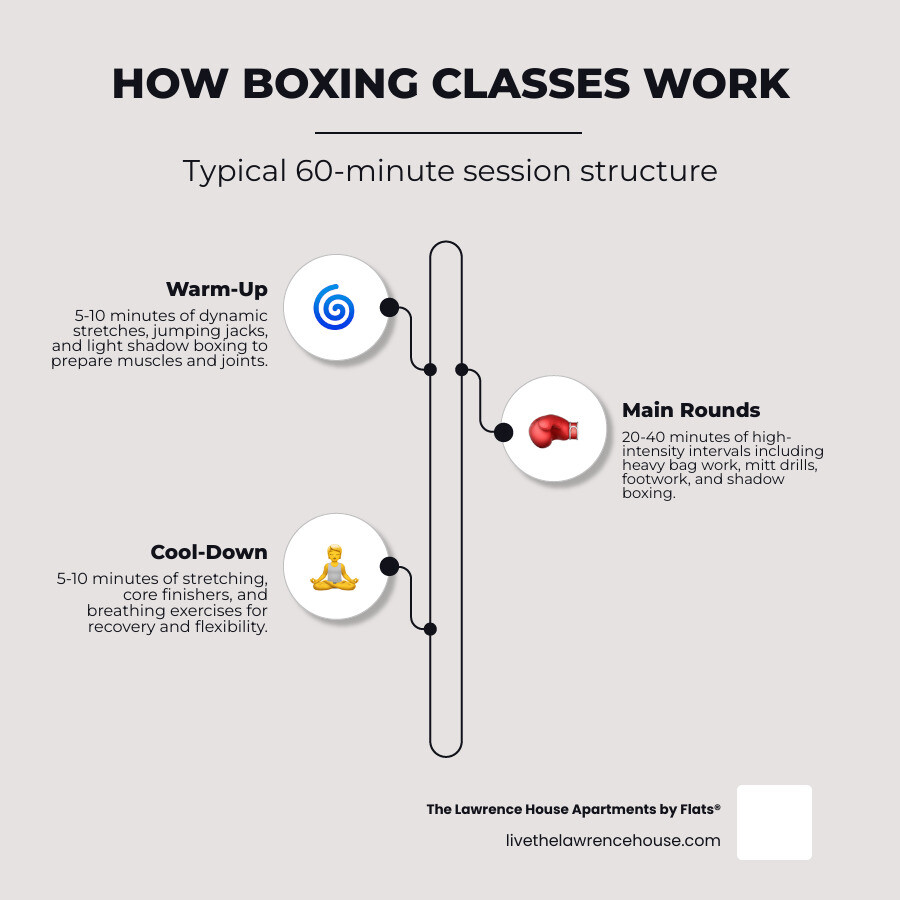
Most boxing exercise classes last between 45 and 60 minutes, though some advanced "Champ" formats can go for 90 minutes. A standard session usually follows this flow:
- Warm-up: 10–15 minutes of shadow boxing, jumping rope, or bodyweight exercises to get the heart rate up.
- The Rounds: Typically 8 to 10 rounds of bag work. Each round lasts about 3 minutes, followed by a period of "active recovery" (like planks or squats) to keep the heart rate elevated.
- The Finisher: A dedicated block for core strength and conditioning.
- Cool-down: Stretching and recovery.
6. What gear to bring and what gyms usually provide
You don't need a lot of gear to start, but you do need the basics. Most studios require boxing gloves and hand wraps. Hand wraps are essential for protecting the small bones in your hands and supporting your wrists.
For your first day, many gyms offer glove rentals, but you will usually need to purchase your own wraps for hygiene reasons. Always arrive at least 30 minutes early for your first session so the staff can show you how to wrap your hands and teach you the basic stance. For more tips on getting started, check out this guide on boxing for beginners Chicago.
7. How gyms keep classes low-contact and injury-conscious
Safety is a priority in modern fitness boxing. Studios employ no-contact policies to ensure everyone feels comfortable. Coaches provide constant demonstrations and one-on-one corrections to ensure your form is correct. Using heavy bags provides the necessary resistance to build strength without the risk associated with hitting a person. Proper posture and footwork are taught early on to prevent strain on the joints.
8. Which class formats match goals like weight loss, self-defense, or toning
Not all boxing exercise classes are the same. Depending on your goals, look for these formats:
- HIIT Boxing: Best for maximum calorie burn and weight loss.
- Strength-Focused: Uses heavier bags (often 120 lbs) and incorporates dumbbells or kettlebells between rounds.
- Fundamentals: Best for those who want to learn real self-defense basics and proper punching mechanics.
- Advanced Bag Work: Focuses on complex combinations and footwork for those who have mastered the basics.
9. What real participants usually say after their first few sessions
The most common feedback from new boxers is how quickly the "intimidation factor" fades. While walking into a boxing gym can feel daunting, the community environment is usually incredibly welcoming. Participants often report feeling "empowered" and "accomplished" after a tough session. The camaraderie found in group classes—often involving high-fives and fist bumps between rounds—creates a "fitness family" atmosphere that makes it easier to stay consistent.
How to Find the Best Boxing Exercise Classes Near You in Chicago
Chicago is a legendary boxing city, and that heritage has translated into some of the best fitness studios in the world. From the historic gyms of the South Side to modern studios in Uptown, there is no shortage of places to "show you the ropes."
10. What to check before booking a free trial or first class
When searching for "boxing classes near me," look for studios that offer a free trial. This allows you to test the vibe of the gym without commitment. Check the schedule to ensure they have dedicated beginner levels or "fundamentals" sessions. You should also look into their equipment policy—do they rent gloves, or must you buy them? Finally, consider the commute; a gym that is easy to reach via the "L" or has easy parking will be much easier to visit three times a week.
11. Where to look in Uptown and nearby Chicago neighborhoods
If you are living in or visiting the North Side, Uptown is a fantastic hub for fitness. The neighborhood offers a mix of gritty, authentic boxing gyms and high-end fitness centers. Having a high-quality boxing gym Uptown nearby makes it much easier to stick to a routine.
Whether you are looking for a fitness center Uptown or exploring the best gyms in Uptown, the variety in this area is impressive. For a complete look at your options, you can browse this guide to gyms in Uptown Chicago.
12. How to get started and build boxing into a weekly routine
Consistency is the key to seeing results. Most people find success by booking their classes online a week in advance to stay accountable. Start with two sessions a week to allow your muscles (especially your shoulders and core) time to recover.
As you get comfortable with the movements, you can increase your frequency. Many residents at The Lawrence House take advantage of our on-site amenities to supplement their training. Our two-level gym at Uptown is perfect for those "active recovery" days when you want to focus on mobility or light cardio.
To see how a luxury lifestyle and top-tier fitness can blend together, explore our amenities or read more about Uptown fitness to find your perfect rhythm. Boxing is more than a workout; it is a way to find your strength, and there is no better place to start than right here in the heart of Chicago.